AI workflows vs agents: control, cost and when to use each
 Khaled Al-Nashery
- 26 Nov, 2026
- 08 Mins read
The useful question is not whether a system uses AI. It is who chooses the next action when a support ticket stops following the expected path — the boundary Anthropic and AWS both draw. Use the same ticket to compare code-owned routing with model-owned investigation, then test outcomes rather than claiming a winner without a same-case trial. My preference: keep the fixed path until an unpredictable next decision earns autonomy.
AI workflows vs agents: who chooses the next action?
Anthropic defines workflows as systems in which LLMs and tools run through predefined code paths. Its agents let the model direct its own process and tool use. That is a control-flow distinction, not a claim that one design uses AI and the other does not. A workflow may classify a ticket with a model and branch on that output; code still decides which branches exist and when the run ends. An agent can choose which permitted evidence source to inspect next, whether to retry a search, and when to return a finding. Its developer still sets tools and permissions. AWS makes this same distinction.
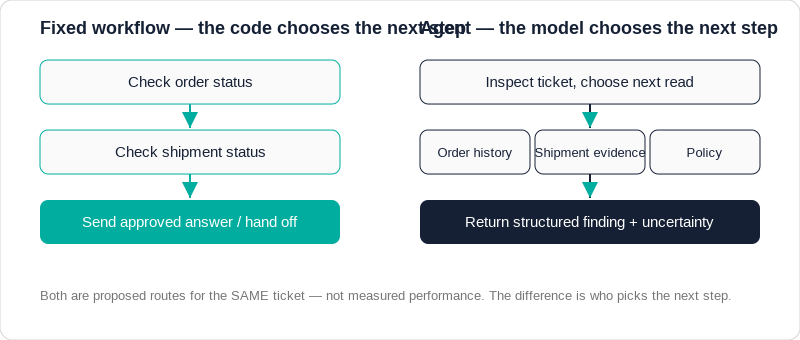
Consider a customer asking why a replacement has not arrived. The fixed route checks the order, checks shipment status, and sends the approved answer or hands off. The exploratory route might inspect an unexpected warehouse exception before choosing its next read. These are proposed routes for the same ticket, not observed performance results. Branching does not itself make the fixed route autonomous; the question is who chooses the available next step.
Where a fixed workflow or an agent fits
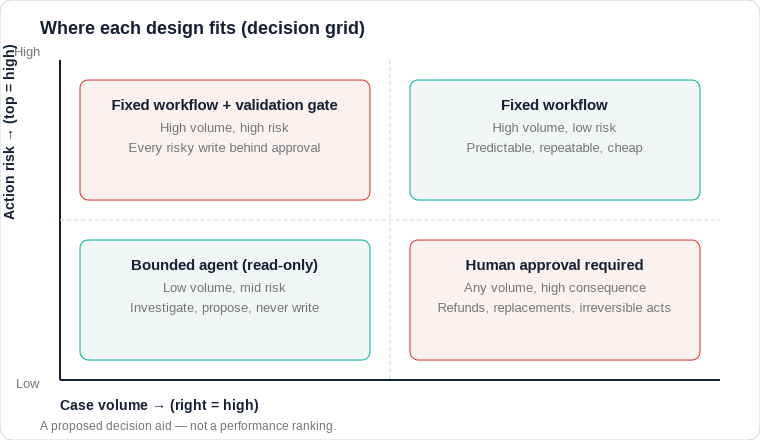
For high-volume tickets with known verification and response steps, use a code-owned route, even if the ticket text is unfamiliar. An unknown input is not necessarily an unknown procedure. AWS compares a structured ticket workflow, a bounded investigation and an autonomous design. Under the same delayed-replacement ticket, the first can check known systems and apply a response rule; the second can investigate an exception the rules did not settle. Neither deserves a success claim until both face the same cases.
A model-selected investigation is worth considering when the next useful read cannot be scripted economically, the exception is consequential, and the model can explore without making a risky change. If the ticket instead needs a refund, approval and a controlled write matter more than flexible search. Veridive advises a narrow goal, limited tools, a step budget and a defined stop or handoff. These are design choices, not measured guarantees.
Workflow automation vs AI agents: a decision boundary
Ask: Can we specify the next checks in advance? How often does the exception occur? What does a wrong action cost? A predictable, frequent route favors code. An uncertain but valuable exception may justify bounded, read-only exploration. A high-risk write belongs behind validation and approval regardless of which route found the answer. This grid is a proposed decision aid, not a performance ranking. Veridive’s comparison also separates predictable workflow calls from agent-selected calls and recommends narrow agent boundaries.
Testing, reliability, latency and cost side by side
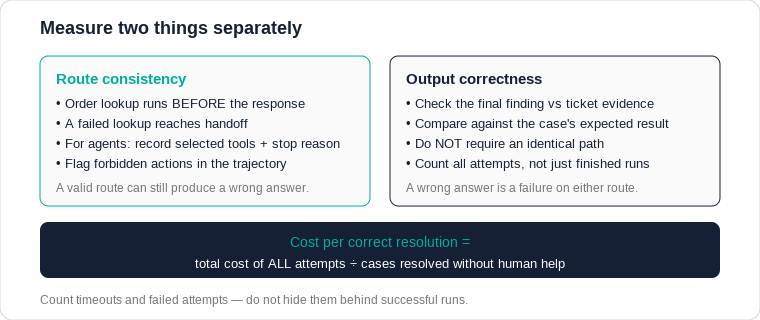
Test route consistency separately from output correctness. For a fixed route, assert that order lookup precedes the approved response and that a failed lookup reaches handoff. For an exploratory route, record the selected tools and stop reason, then check the final finding against the ticket evidence. Either system can take an acceptable route and still produce a wrong answer; a different valid route need not be a failure. Retool notes that varied agent paths make tracing important.
At each step, log malformed inputs, validation failures, retries and attempts to use disallowed tools. End to end, measure correct autonomous resolution, escalation, p95 latency, tokens, tool calls and total cost. Count timeouts and unsuccessful attempts rather than hiding them behind successful runs. AWS defines AWS cost per correctly resolved case as total AWS cost of all attempts divided by cases correctly resolved without human intervention; track human review cost separately. Anthropic describes potential latency and cost trade-offs, not guaranteed agent gains.
Redis illustrates a 99%-reliable step repeated 10 times yielding roughly 90% overall success. That is multiplication under an independence assumption, not a measured agent benchmark. Actual errors can be correlated, retried or caught by checks; measure the real ticket outcomes instead.
How to replay the same cases without conflating path with outcome
Freeze a ticket set with expected resolution, allowed actions and prohibited side effects. Give both designs the same model, evidence snapshot, tool permissions, timeout and escalation policy where feasible; document any permissions that necessarily differ. Replay each case, retaining the route, tool responses, validation failures, retries and final state. For fixed routing, assert expected branch and step outputs. For the agent, inspect the trajectory for forbidden actions and check the final answer against the case’s expected result, without requiring a single identical path. Compare correct resolutions and cost over all attempts, not just the runs that finish. AWS’s evaluation denominator makes failed attempts visible. This is a test protocol to run, not a claim that these tickets have been tested.
The hybrid: put autonomy inside an action boundary
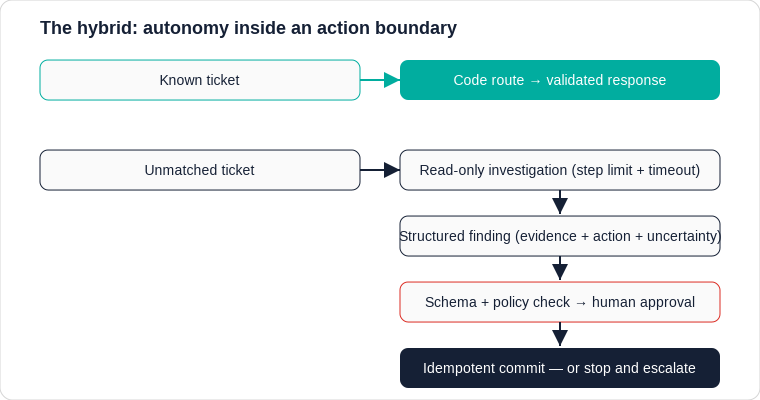
Route recognized cases by code. When a ticket fails the known checks, permit the agent to read order history, shipment evidence and policy, with a step limit and an explicit handoff on timeout. Require it to return a structured proposal containing evidence, proposed action and uncertainty. Validate the schema and business rules; send any refund or replacement proposal for human approval. Only the controlled execution step may write, using a stable operation identifier so a lost response and retry do not create a second action. AWS explicitly warns that a retry must not cause a second refund or replacement order; Veridive calls for a small tool set and a clear stop.
This design specifies permissions and a proposed retry boundary; it does not report a deployed system. Do not grant a research tool the ability to commit a refund merely because the agent can explain one.
What to measure before adopting an agent
Make a per-case worksheet before selecting a winner. Define “correct” against the same ticket evidence; count all attempts, including failures and retries. Record both route and outcome so a correct resolution does not hide a forbidden write. Here is one row filled from our own run, as an example of what the template looks like in use:
| Case ID | Expected result | Chosen path | Correct without human help? | Attempts and retries | Validation failures | Duplicate side effects | Escalated? | Latency | Tokens and tool calls | AWS cost of all attempts |
|---|---|---|---|---|---|---|---|---|---|---|
| Q1 (refund INV-1001) | eligible — 12 days < 30-day window | refund_status → get_order → get_refund_policy | Yes | 1 (no retries) | 0 | 0 | No | ~2s | 2 tool calls, 1 model call | — (local run, no AWS) |
Columns marked — were out of scope for a local run with no AWS spend. The aggregated results across all 12 cases follow.
Aggregate correct autonomous resolutions over all eligible cases, p95 latency over a declared set of attempts, escalation rate and duplicate side effects. Divide total AWS cost of all attempts by cases correctly resolved without human intervention for AWS cost per correct resolution, as AWS specifies; report human costs separately. If there are no correct autonomous resolutions, report the denominator as zero and the ratio as undefined. Include per-case failures and timeouts. Redis’s reliability example and vendor comparisons are not an independently run, apples-to-apples ticket dataset. Do not turn them into comparative results.
Tested: 108 same-ticket conversations (reproducible, local)
We ran the comparison rather than repeat vendor claims. Three designs — a fixed workflow, an unbounded agent, and a hybrid — answered the same 12 frozen support-ticket questions across 3 seeds (108 conversations) on a local qwen2.5-coder:7b (Q4_K_M) model via Ollama 0.30.11 on an NVIDIA RTX 5060 Laptop (8 GB), temperature 0, seed-controlled, run 2026-11-26. The harness, frozen dataset and every transcript are open source at github.com/workflowatlas241-lang/workflow-vs-agent — clone and re-run to reproduce. Absolute numbers are illustrative on a small local model; the point is the pattern, not the percentages.
| Design | Correct | Wrong | Handoff | Routing errors | Avg model calls | Avg tokens/run | Median latency |
|---|---|---|---|---|---|---|---|
| Fixed workflow | 21/36 (58%) | 0 | 12 | 3 | 1.67 | 151 | 1.64s |
| Unbounded agent | 27/36 (75%) | 9 | 0 | 0 | 2.00 | 771 | 2.22s |
| Hybrid (bounded agent) | 33/36 (92%) | 0 | 0 | 3 | 2.00 | 401 | 2.07s |
Three findings, stable across all three seeds:
- The hybrid won. Code-owned routing for known intents plus a read-only agent for the unmatched cases beat both pure designs.
- The agent under-investigated. On “Can I still get a refund for INV-1001?” it called
get_order(12 days ago) and skippedget_refund_policy, then wrongly answered “delivered = no refund.” Nine of its 36 runs failed this way — a concrete instance of the compounding-error risk Redis describes. - The router misread ambiguity. “I want to return a chair I bought” was routed to cancellation instead of refund_status in every seed — a workflow-only failure the agent (no router) never hit.
Token cost tells the same story: the unbounded agent burned 771 tokens per run, the fixed workflow 151, and the hybrid 401 — the highest correctness at roughly half the agent’s token spend.
A “correct” answer means the required facts were retrieved and the conclusion was right; the grader is deterministic substring matching, so any transcript in runs/ can be audited by hand.
Compare your current task with the decision boundary, then explore agentic workflow patterns.
What this comparison does not decide
A commenter discussing durable execution argues that determinism can apply to replay of a particular running execution, not necessarily to a static workflow definition. That is a community distinction, not evidence that dynamic planning performs better. A planned path can vary across executions while each individual execution is replayable. For implementation patterns, follow the agentic workflow patterns guide; for product selection rather than architecture, see best AI workflow automation tools. No controlled, same-task benchmark was available in the cited comparison sources.
FAQ
Can an agent execute a deterministic workflow?
Yes. An agent can choose or launch a workflow whose individual execution can be replayed deterministically. That does not make the agent’s choice of the next workflow a fixed, code-owned path. A community objection about durable execution distinguishes deterministic replay of a running execution from requiring an unchanging workflow graph; treat that as a useful distinction, not a universal performance rule.